Suzi Scene · Arts Funding
A New Way to Fund Atlanta’s Arts
Arts Capital | Atlanta is pooling resources—and asking funders to invest in the health of an entire creative ecosystem.

Atlanta has a reputation as a thriving arts city. But behind that image, many of the nonprofit organizations producing its theatre, dance, music and visual art are operating with small budgets and little financial cushion.
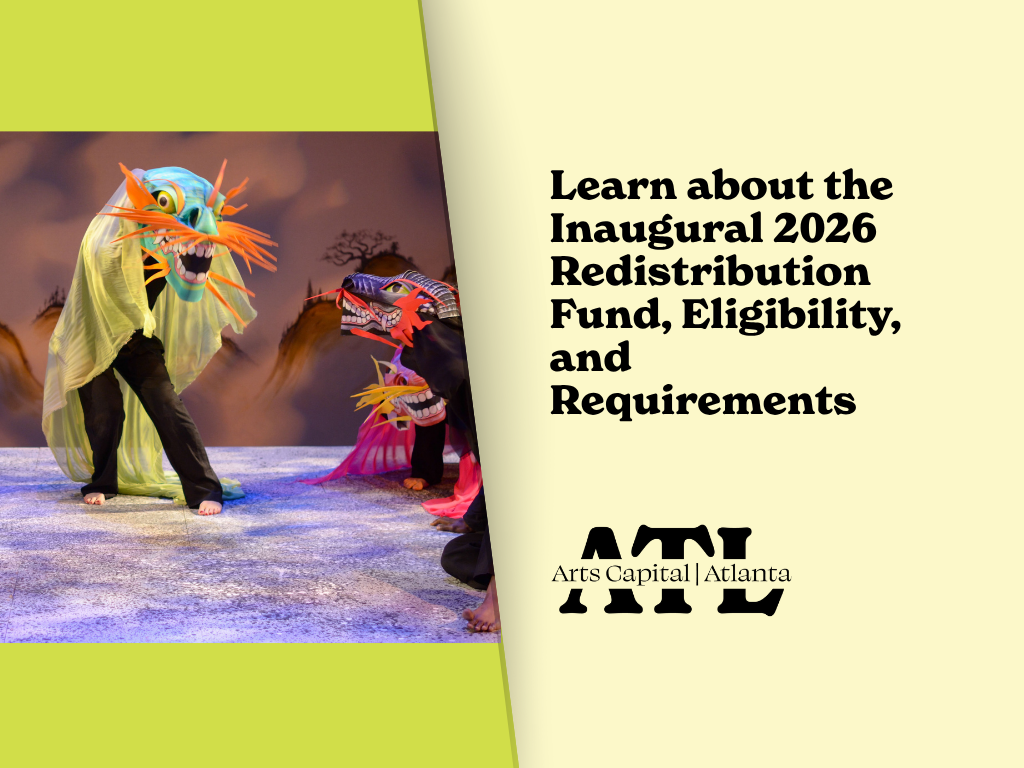
Explore eligibility and requirements →
Arts Capital | Atlanta is trying something different. Beginning October 1, it will accept applications for an inaugural fund that has raised more than $1 million for metro Atlanta arts organizations.
Funding the ecosystem
The money will not be awarded through a traditional grant competition. There is no narrative proposal, and applicants will not be judged on writing quality or artistic merit. Instead, contributions from funders have been pooled and will be distributed as unrestricted grants among qualifying organizations.
As many as 200 organizations may be eligible, with individual awards expected to range from $2,000 to $5,000. Recipients will decide for themselves where the money is most needed—whether that means paying an artist or staff member, covering rent or insurance, supporting a program or creating some breathing room in an operating budget.
Laura Hennighausen, Director of Strategic Philanthropy at Purpose Possible and facilitator of Arts Capital, said the initiative grew from the recognition that many of the problems confronting Atlanta arts organizations are systemic.
“Half of the nonprofit arts organizations in our region operate on less than $150,000 a year, many have very limited reserves, and public investment in the arts here is well below the national average.”— Laura Hennighausen
An individual organization can pursue more grants, raise more money or reduce expenses, but none of those steps repairs the larger funding system. Arts Capital is intended to give organizations a way to work together on broader goals, including increased public and philanthropic investment, better data about the sector and a stronger collective voice.
Arts leaders have helped design the eligibility requirements, application and distribution process. Rather than asking funders to select a small group of winners, the model asks them to invest in the health of the arts ecosystem as a whole.
A larger possibility
Atiba Mbiwan, Executive Director of the Zeist Foundation, said many private funders in Atlanta do not have a specific category for the arts. Arts Capital can help them see how supporting the arts also advances priorities such as education, health and community development.
“Working together is always better, and our arts movement needs us now more than ever.”— Atiba Mbiwan
No one involved believes the first grants will solve the sector’s long-term financial problems. Hennighausen describes the initial distribution as a pilot and “a starting point, not an endpoint.” It will test the model, generate better information about participating organizations and help demonstrate the scale of investment the region actually needs.
Mbiwan sees an even larger possibility: a $100 million fund that begins with this first $1 million distribution and could eventually inspire a statewide effort.
For now, the immediate goal is to reach as many eligible organizations as possible.
Applications & information
Applications open October 1 and close October 29, 2026. An online open house takes place Tuesday, October 6, at 1 p.m.